Reviewed and fact-checked by the HomeDecoria Editorial Team — May 19, 2026
A beautiful kitchen that doesn’t work is just expensive decoration. The difference between a kitchen you love using and one that frustrates you every day usually comes down to inches — the clearance between the island and counter, the height of upper cabinets, the width of the main walkway. Get the dimensions right and a small kitchen feels generous. Get them wrong and even a 200-square-foot kitchen feels cramped. Here are the standard 2026 dimensions every kitchen needs to nail, plus the tradeoffs that decide which ones you can flex on.
The Five Standard Kitchen Layouts
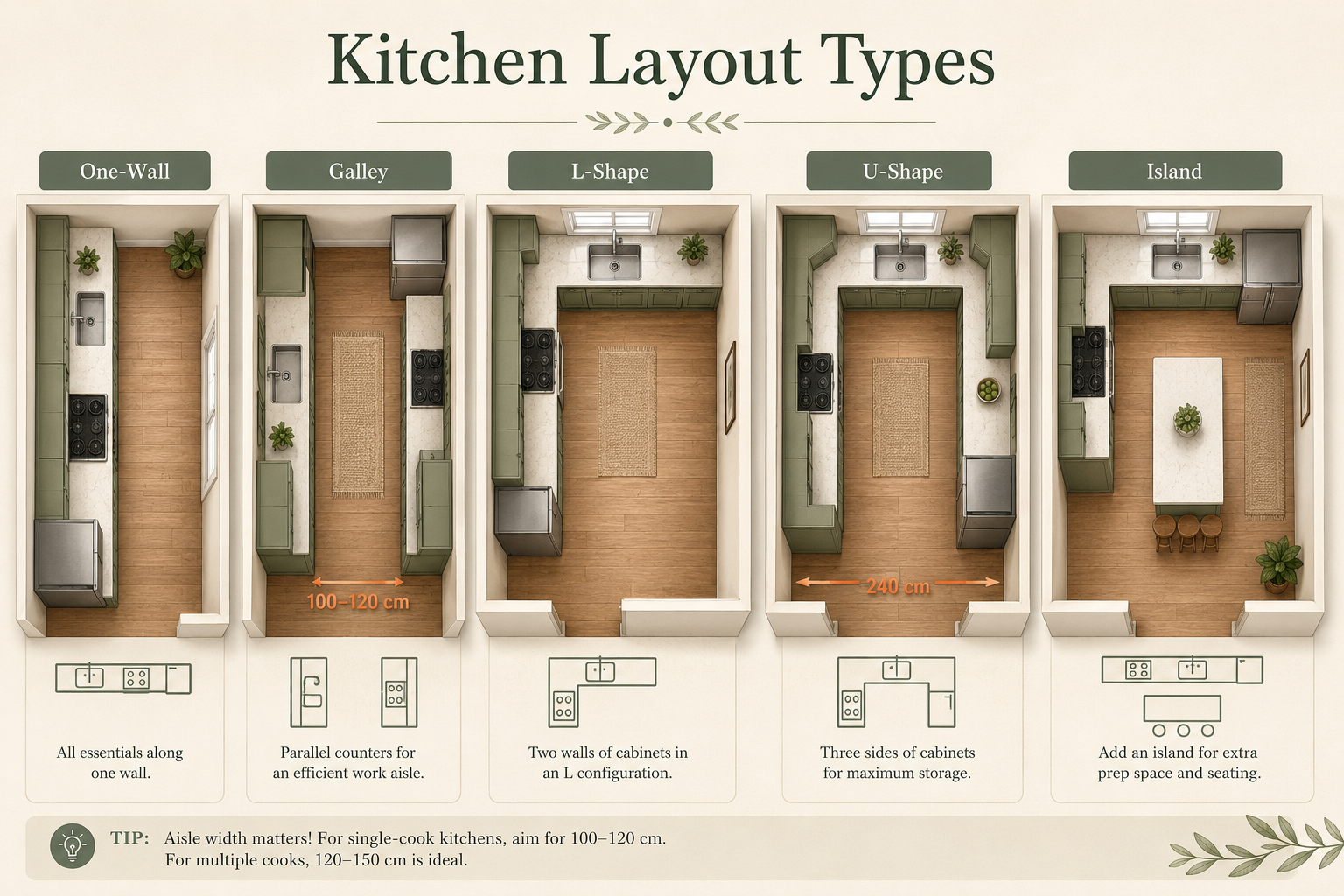
Before any dimension matters, the overall layout has to fit the room. Five layouts cover almost every kitchen built in 2026:
- One-wall — all cabinets and appliances on a single wall. Best for studios and small apartments. Minimum wall length: 270 cm (~9 ft).
- Galley — two parallel runs of cabinets. The most efficient layout per square foot. Aisle between runs must be 100–120 cm (39–47 in).
- L-shape — cabinets on two adjacent walls. Most flexible layout, works in almost any room shape. Add an island if the open leg has space.
- U-shape — cabinets on three walls. Maximum storage, three-zone workflow. Needs at least 240 cm (~8 ft) of opening width to avoid feeling boxed in.
- Island-centric — perimeter cabinets plus a freestanding island. The most popular layout for new builds, but needs at least 4 × 4 m (13 × 13 ft) total room size to work without cramping.
Pick the layout first; only then do the individual dimensions start to matter.
The Work Triangle Still Matters
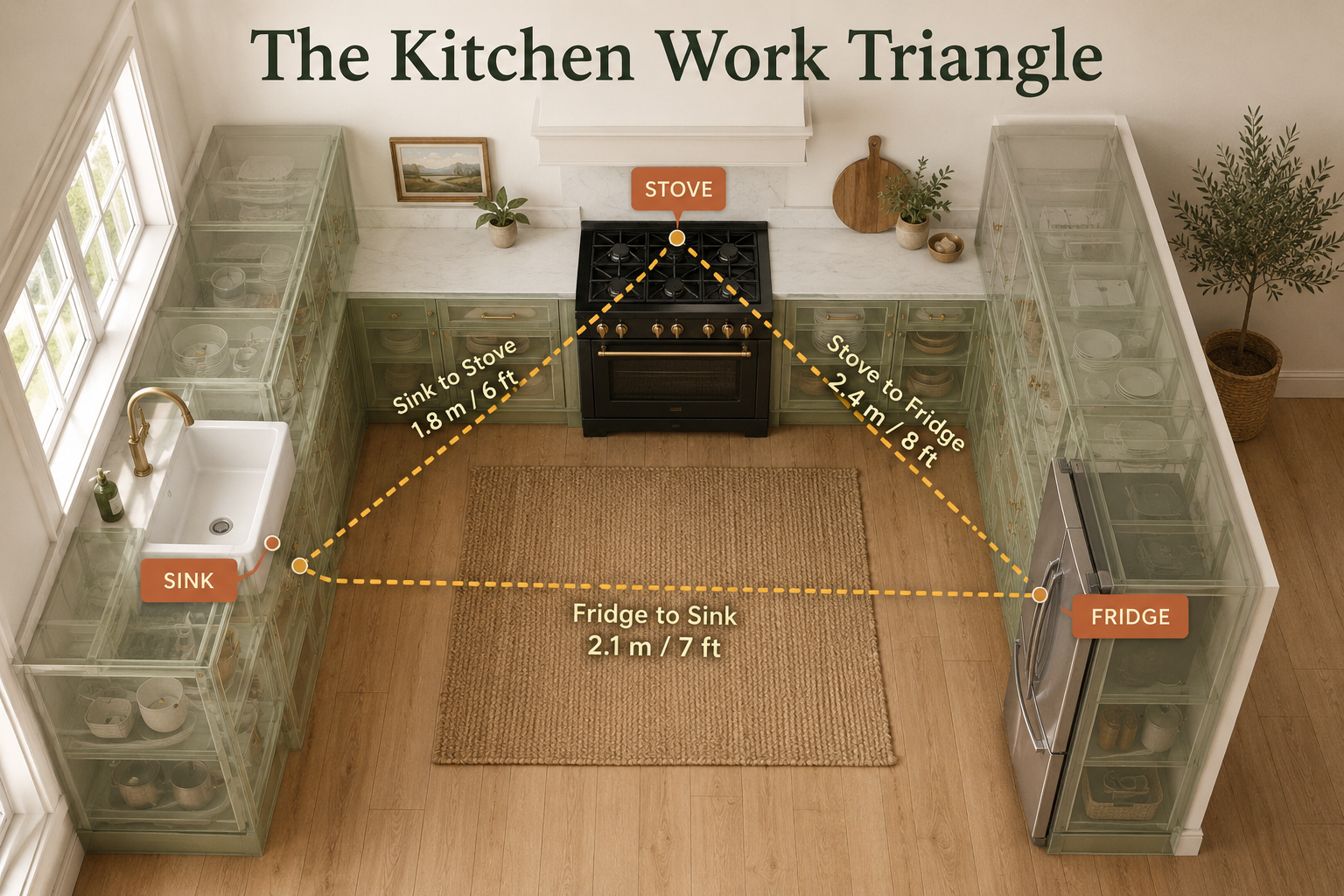
Sink, stove, and refrigerator form the three points of the classic work triangle — the path you walk thousands of times a year while cooking. The rule still holds in 2026: each leg between 1.2 m and 2.7 m (4–9 ft), with a total perimeter of 4 m to 8 m (13–26 ft). Under 4 m and the kitchen feels cramped and unsafe (hot pans crossing paths with the fridge door). Over 8 m and you’ll walk thousands of extra steps a year — fatigue piles up fast in a kitchen that’s too spread out.
In larger 2026 kitchens, designers also plan a second triangle for the secondary cook or coffee station — fridge, sink, and small-appliance counter — so two people can work without crossing paths.
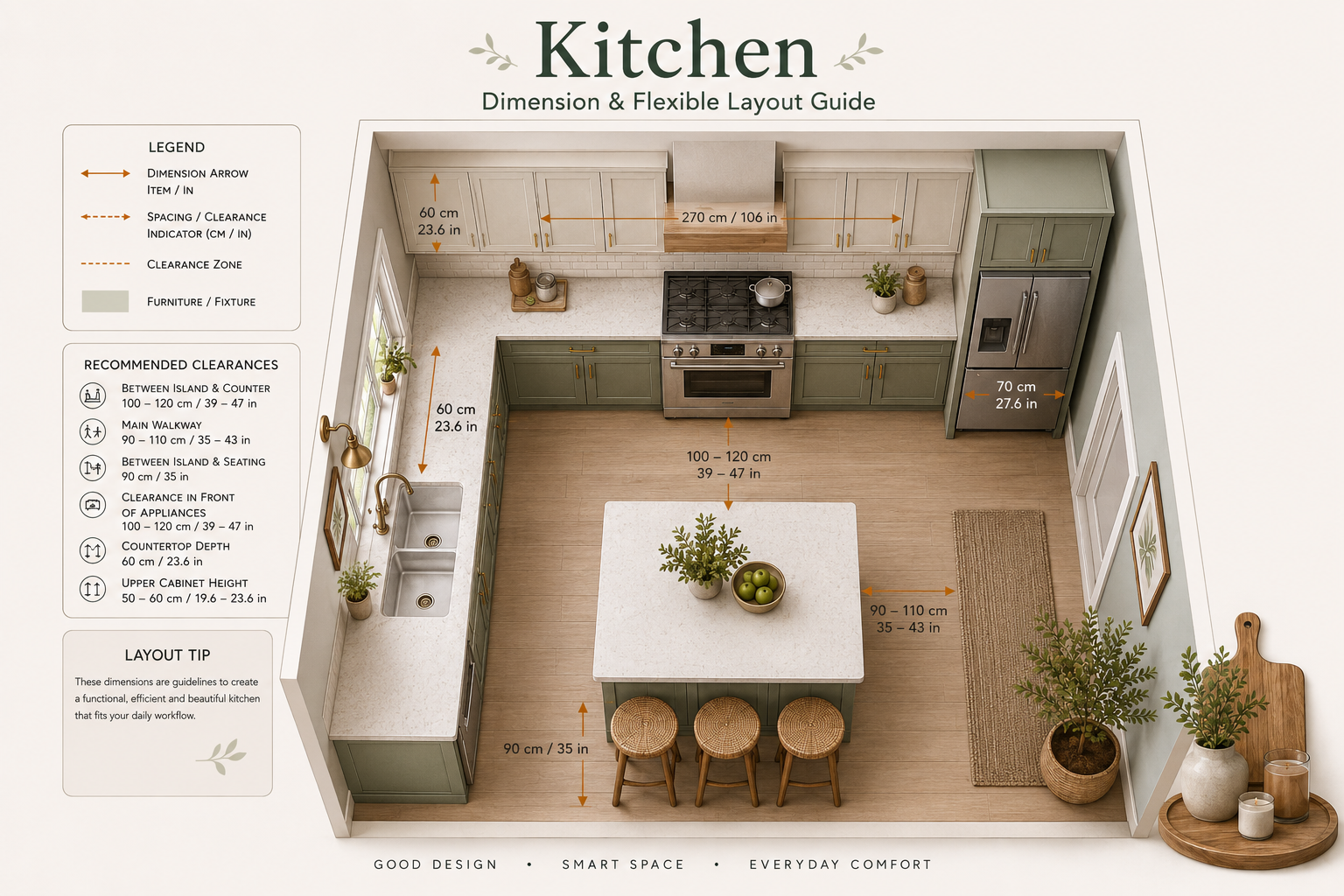
Island-to-Counter: 110–120 cm (43–47 in)
The single most important dimension in a modern kitchen. Below 100 cm (39 in), two people can’t pass without dancing around each other. Above 120 cm (47 in), the cook takes an extra step every trip between island prep and stove. 110 cm (43 in) is the sweet spot for couples who cook together. If only one person ever uses the kitchen at a time, you can drop to 100 cm; if three or more cooks share the kitchen at holidays, push to 120 cm.
One detail most homeowners miss: the 110 cm measurement is from cabinet face to cabinet face, not countertop edge to countertop edge. Counter overhangs (typically 2.5 cm / 1 in on each side) reduce the usable walking space.
Main Walkway: 90–110 cm (35–43 in)
Any walkway that isn’t between island and counter — past the fridge, into the kitchen from the hallway, behind island stools — needs 90 cm minimum. Tighter than that and one person blocks the whole kitchen. In high-traffic kitchens (open-plan homes where the kitchen is a thoroughfare), go to 110 cm so people can pass without interrupting the cook.
Behind Island Stools: 90 cm (35 in)
Measure from the back of a pulled-out stool to the nearest obstacle. Less than 90 cm and diners feel hemmed in; chairs scrape the opposite counter every time someone sits down. If the area behind the stools is a main walkway (people walking past while others eat), push this to 110 cm so passersby aren’t brushing against the people seated.
In Front of Appliances: 90 cm (35 in)
Dishwasher open, fridge wide, oven mid-bake — each needs at least 90 cm of clearance in front. Non-negotiable for safety: hot trays and open appliance doors are how most kitchen injuries happen. The clearance has to be there with the door fully open, not just “when the dishwasher is closed.” Many kitchens look spacious until the dishwasher drops down and blocks the whole work zone.
Special case: the dishwasher should sit directly next to the sink — within 60 cm (24 in) of the sink basin — to keep plumbing runs short and the rinse-then-load workflow tight.
Upper Cabinets: 50–60 cm (19.6–23.6 in) Above Counter
Less than 50 cm and a stand mixer or tall blender won’t fit on the counter. More than 60 cm and shorter cooks can’t reach the top shelves without a step stool. The 50–60 cm window is the universal compromise. If anyone in the household is under 165 cm (5’5″) tall, stay at the lower end (50–55 cm). If everyone is 175 cm+ (5’9″+), 60 cm gives you more breathing room and a less cluttered visual on the wall.
Upper cabinets themselves are typically 30–40 cm deep (12–16 in). Going deeper than 40 cm puts the bottom shelf into your line of sight while working at the counter — and people start bumping their head.
Counter Depth: 60 cm (23.6 in)
Standard counter depth matches base cabinets (60 cm / 24 in) and most appliances. Going deeper than 60 cm looks generous but creates a hard-to-reach zone at the back that turns into clutter storage within a month. Save the extra depth for islands, where prep surface matters more than reach — island countertops can run 90–120 cm wide (36–48 in) with seating overhang on one side.
Cabinet Run Width: 270 cm (~9 ft) Sweet Spot
For a single wall of base cabinets, 270 cm is the most efficient length — enough for sink + dishwasher + 100 cm of prep + range. Over 320 cm (~10.5 ft) and you’ll walk too much between zones; under 240 cm (~8 ft) and you sacrifice prep space. If your run is longer than 320 cm by necessity, break it into zones with a tall pantry cabinet in the middle to keep the active work area compact.
Stove, Hood, and Range Specifics
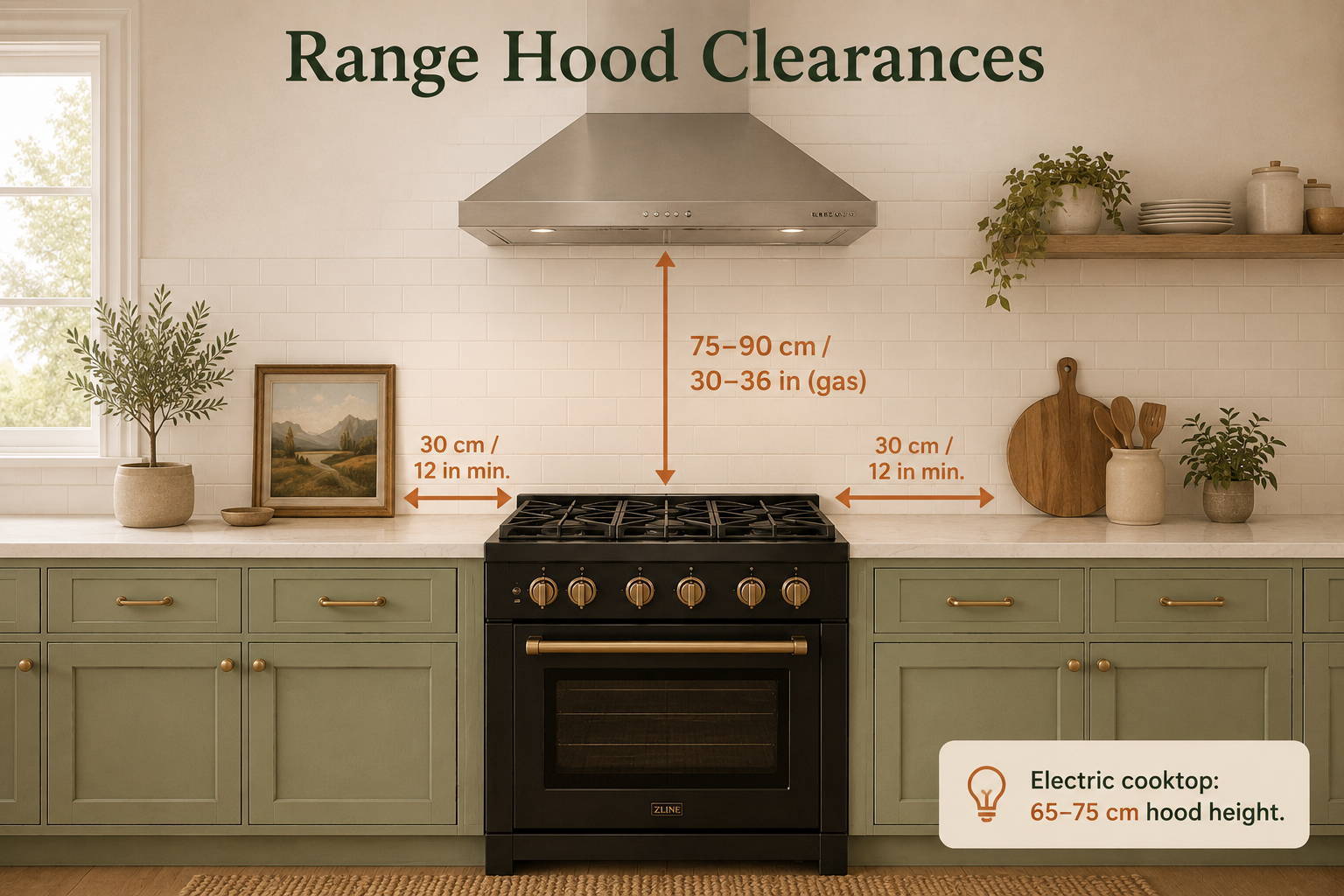
Range hoods need to sit 65–75 cm (26–30 in) above an electric cooktop and 75–90 cm (30–36 in) above a gas cooktop. Closer than that risks heat damage and grease buildup; further and the hood loses capture efficiency. Allow at least 30 cm (12 in) of counter on each side of the range for landing space when pans come off the heat.
Gas ranges also need clearance to combustibles on the sides — check the manufacturer spec, but 30 cm to flammable cabinetry is a common minimum.
Sink and Faucet
A single-bowl sink should be at least 75 cm wide (30 in) and 22 cm deep (8.5 in) — anything smaller and a large pan won’t fit flat. Double-bowl configurations have lost popularity in 2026 (most homes own a dishwasher, so the second bowl just splits prep space). Faucet height should clear your tallest pot by at least 5 cm (2 in) — pull-down faucets typically sit 35–40 cm tall.
Outlets and Lighting
Code in most US jurisdictions requires a counter outlet every 4 ft (120 cm), with no point along the counter more than 2 ft from an outlet. Place pendant lights 75–90 cm (30–36 in) above the island countertop — closer and tall guests bump into them, further and the pendant loses its visual anchor over the island. Use one pendant per 60–75 cm (24–30 in) of island length.
Toe Kicks, Drawers, and Other Details
Toe kicks (the recessed space at the base of cabinets) should be 7–10 cm (3–4 in) tall and 7–8 cm (3 in) deep — this lets you stand at the counter without your toes hitting the cabinet face. Deep drawers (rather than doors with shelves) are now standard in 2026 base cabinets — you can see everything inside without crouching. Plan at least one bank of three deep drawers for pots and pans.
Common Mistakes That Break Otherwise Good Kitchens
- Dishwasher in the corner — when it opens, the door blocks the corner cabinet entirely. Always keep at least 60 cm between dishwasher edge and the corner.
- Fridge against a wall on the hinge side — you can’t open the door fully, so crisper drawers won’t pull out. Leave 5 cm (2 in) on the hinge side.
- No landing space next to the fridge — groceries get dumped on the floor while you sort them. Plan at least 40 cm of counter directly adjacent to the fridge.
- Microwave above the range — popular but ergonomically wrong for cooks under 170 cm (5’7″). Use a microwave drawer in the island instead.
- Pendant lights centered over the wrong axis — pendants should align with the island’s long centerline, not with whatever feature is above on the ceiling. Plan electrical rough-in after the island position is final.
The Tip Most People Miss
These numbers are guidelines, not laws. Real kitchens have load-bearing walls, plumbing constraints, and weird angles. The goal isn’t to hit every number — it’s to know which ones matter most for the way you cook. Bakers prioritize counter run length and uninterrupted prep zones. Couples-who-cook prioritize island-to-counter clearance and a second triangle. Parents with young kids prioritize walkway width and sightlines from kitchen to living area. A kitchen built around your actual workflow will outperform a textbook kitchen built around someone else’s.
Quick-Reference Cheat Sheet
- Island-to-counter clearance: 110 cm / 43 in (sweet spot)
- Main walkway: 90–110 cm / 35–43 in (never below 90)
- Behind island stools: 90 cm / 35 in (110 cm if walkway)
- In front of appliances: 90 cm / 35 in with door open
- Upper cabinets above counter: 50–60 cm / 19.6–23.6 in
- Counter depth: 60 cm / 24 in (deeper only on islands)
- Cabinet run: 270 cm / ~9 ft (most efficient single-wall length)
- Range hood above cooktop: 65–75 cm electric, 75–90 cm gas
- Pendant lights above island: 75–90 cm / 30–36 in
- Counter outlet spacing: every 120 cm / 4 ft (US code)