How to Decorate a Small Living Room: 8 Rules That Make Any Space Feel Bigger
How to Decorate a Small Living Room
8 rules that make any space feel bigger — the furniture choices, layout principles, and specific upgrades that work in tight spaces.
Space-Expanding TricksFurniture SizingApartment LivingUnder $500 TotalMost small living rooms feel cramped not because they’re actually small, but because of the decisions made inside them. Over-scaled furniture, too many pieces, wrong rug size, curtains hung too low — these mistakes compress a room visually far beyond its actual dimensions.
The rules below come from how professional interior designers approach small spaces. Apply even half of them and the same room will feel significantly larger.
8 Rules for Small Living Rooms
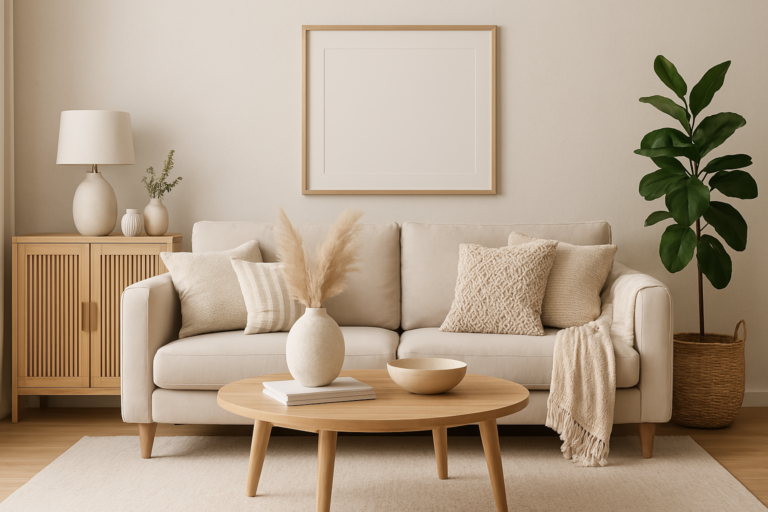
- Buy the Right-Sized Sofa — Not the Biggest That FitsA sofa should be a maximum of 2/3 the length of the wall it sits against. In a 12-ft room, that’s an 8-ft (96″) maximum. Most apartments need a sofa under 84″. A loveseat (60–72″) often works better than a full sofa in rooms under 150 sq ft.Rule of thumb: if you can’t walk 3 feet behind it, it’s too big.
- Hang Curtains at Ceiling Height, Full WidthThis is the single highest-ROI trick for any small room. Mount the rod 2–4 inches below the ceiling, extending 12–18 inches beyond the window on each side. Floor-length panels make the ceiling feel higher and the windows feel larger — both visually expand the room.Effect: adds perceived height and width simultaneously.
- Use One Large Rug Instead of Multiple Small OnesA 5×7 rug in a small living room makes the space feel more fragmented, not more defined. Go as large as possible — at least front legs of all seating on the rug. One 8×10 in a small room looks more intentional than a small rug and bare floor combination.Too-small rugs are the most common small room mistake.
- Use a Mirror to Double Perceived DepthA large mirror (24″+ diameter or 24×36″+ rectangle) placed opposite a window doubles the natural light and creates the illusion of a second room beyond. In very small living rooms, a floor-leaning mirror in a corner achieves the same effect.Reflects light and creates the illusion of depth.
- Mount Everything You Can on the WallFloor lamps, side tables, shelves — any element with a floor footprint takes up visual space. A wall-mounted shelf replaces a side table. A wall sconce replaces a floor lamp. Freeing floor space is the fastest way to make a room feel larger.Every square foot of visible floor makes the room feel bigger.
- Limit Furniture Legs to the Same Color as the FloorLight legs on dark floors, and dark legs on light floors, create visual interruptions that fragment the room. Match leg color to floor color and furniture visually “floats” — the floor reads as continuous, expanding perceived square footage.The invisible furniture trick used in every staged model home.
- Use a Light, Consistent Wall ColorOne color throughout — walls, trim, and ceiling in the same or very similar tones. Light warm whites and pale greiges visually push walls outward. High-contrast trim defines boundaries that make rooms feel smaller. The most space-expanding approach is a monochromatic light palette throughout.Avoid dark accent walls in rooms under 150 sq ft.
- Edit Ruthlessly — Less Is MoreEvery object in a small room competes for visual attention. A credenza with 5 items on top reads as clutter; a credenza with 1–3 items reads as styled. Remove everything from surfaces and put back only the best 30%. The negative space is part of the design.The hardest rule — and the most impactful one.
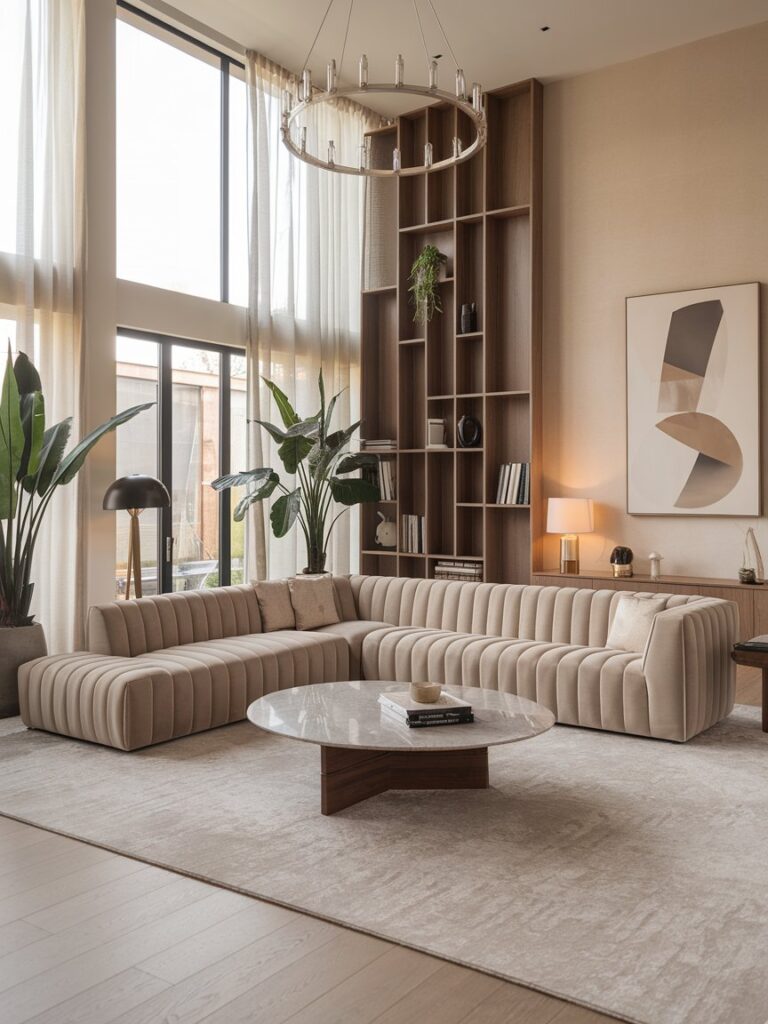
In small rooms, use height. Tall bookshelves (floor-to-ceiling), high-hung curtains, tall plants — all draw the eye upward, making the room feel larger than its footprint. Most small rooms are under-furnished vertically and over-furnished horizontally. A single tall bookcase in a 10×12 room does more for the space than a wide console table against the same wall.
Do’s and Don’ts for Small Living Rooms
Do
- Use glass or lucite coffee table (visually disappears)
- Choose furniture with legs (vs. on-the-floor pieces)
- Hang curtains as high and wide as possible
- Use one large rug over multiple small ones
- Mount TV to wall (no TV stand)
- Use multi-purpose furniture (storage ottoman, nesting tables)
- Keep the dominant color light and neutral
Don’t
- Use a too-small rug (makes room feel fragmented)
- Push all furniture against the walls (creates a bowling alley)
- Hang curtains at window frame height
- Use a sectional in rooms under 200 sq ft
- Over-accessorize every surface
- Use too many patterns simultaneously
- Choose furniture wider than 2/3 the wall it’s against
Top Picks That Work in Small Living Rooms
A 71″ linen sofa that converts to a sleeper — two functions in small-room-appropriate dimensions. The slim profile and tapered legs keep the visual footprint light. Gray linen pairs with any accent color.
Pros
- 71″ — right for most small rooms
- Converts to sleeper (guest solution)
- Tapered legs — visually lighter
- Gray pairs with everything
Cons
- Futon mattress is not premium
- Back cushions not reversible
Two nesting side tables that occupy the footprint of one. The glass top is visually transparent — it takes up near-zero visual space while providing actual surface area. Stack when not in use, spread when needed.
Pros
- Glass tops = visually invisible
- Nesting saves footprint
- Flexible — spread for guests
- Extremely affordable
Cons
- Glass shows fingerprints
- Assembly required (simple)
A storage bench that serves as coffee table, seating, and storage — three functions in one footprint. At 47″, it works as a coffee table in front of a standard sofa. Interior stores throws, extra pillows, and games.
Pros
- 3-in-1: table + seating + storage
- Velvet lid doubles as soft seating
- Tufted design looks premium
- Internal storage is generous
Cons
- Not rigid enough for heavy items on top
- No tray for drinks (soft lid)
FAQ
Sectionals (too much mass in too many directions), oversized coffee tables, armoires and entertainment centers with closed doors (block light and feel heavy), and any furniture that sits flush to the floor with no legs (visually compresses the space). Also avoid: too many accent chairs — one statement chair is better than two mediocre ones.
Not necessarily — pulling furniture slightly off the wall (even 2–4 inches for the sofa) creates a sense of depth that actually makes the room feel larger, not smaller. The instinct to push everything to the perimeter to “create floor space” often backfires by creating a bowling alley effect. A conversational grouping floating slightly in the room reads as intentional and spacious.
Warm whites (not pure white), pale greiges, light sage, and soft pale blues all expand perceived space. The critical factor isn’t just the wall color — it’s the contrast level. Low contrast throughout (walls, trim, and ceiling all similar tones) removes visual boundaries that make the room feel bounded. High contrast defines edges and makes small rooms feel smaller.