
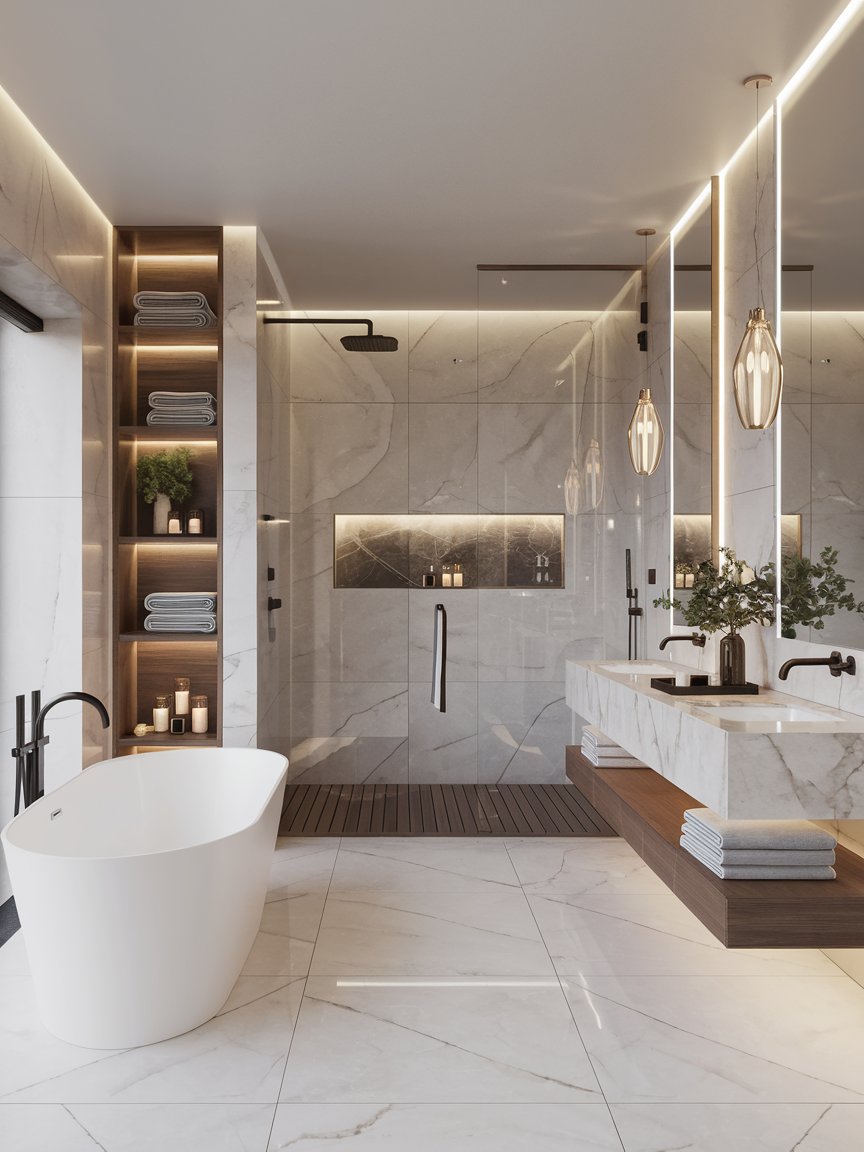
Why Hotel Bathrooms Feel Better Than Yours — and Exactly How to Fix It
Disclosure: HomeDecoria earns a commission through affiliate links in this article, at no additional cost to you. We research obsessively so you can shop confidently.
Walk into any five-star hotel bathroom and something happens in the first three seconds. Before you consciously notice any single detail, your body relaxes. The air feels different. The light is warmer. Everything you touch — the towel, the faucet handle, the countertop — communicates quality through your fingertips.
That feeling isn’t magic. It’s engineering. And you can recreate every bit of it at home. Not with a $40,000 renovation, but by understanding the seven specific elements that luxury hotels invest in — and finding the right version of each for your own space.
We spent two months breaking down what makes high-end hotel bathrooms actually feel different from residential ones. We consulted hospitality design specifications, interviewed a bathroom renovation contractor, and tested dozens of products ourselves. Here’s exactly where the money matters, where it doesn’t, and what to buy.
The towels are the first thing you touch — and hotels know it
The single biggest difference between a hotel bathroom and yours isn’t the tile or the vanity — it’s the towels. Hotels use towels that weigh 600–900 GSM (grams per square meter). The towels hanging in most homes? 300–450 GSM. That’s the gap between wrapping yourself in a cloud versus drying off with a bedsheet.
Turkish cotton at 700 GSM is the industry standard for luxury hospitality. The fibers are longer than regular cotton, which means fewer joins per thread, which means a smoother, more absorbent, more durable fabric that gets softer — not scratchier — with every wash. A set of four bath towels in genuine Turkish cotton costs between $80 and $160 and will outlast a dozen sets of cheap ones.
The specific move: look for “long-staple Turkish cotton” — not just “cotton” or “Turkish-style.” The staple length is what determines quality. Pair them with a heated towel rack (wall-mounted models start around $120) and you’ve just replicated the single most memorable sensation in any luxury hotel bathroom.
👉 Shop 700 GSM Turkish cotton towels | Heated towel racks
The showerhead is doing more work than you think
Hotels don’t use the builder-grade showerhead that came with the plumbing. They use rainfall showerheads — typically 10 to 12 inches in diameter, ceiling-mounted or wall-mounted on a high arm — that transform the water from a targeted spray into an immersive downpour. The difference is immediate and dramatic. It’s the difference between showering under a garden hose and standing in warm rain.
A quality rainfall showerhead costs between $80 and $300. At the high end, brands like Hansgrohe and Delta offer models with air-injection technology that mixes air into the water stream, making each droplet larger and softer while actually using less water. At the entry level, you can find excellent stainless steel options that screw directly onto your existing shower arm — no plumber needed, ten-minute swap.
For the full hotel experience, pair the rainfall head with a handheld wand on a slide bar. This dual-head setup is now standard in luxury hospitality because it provides both the “stand and soak” experience and the practical utility of directed water for rinsing. Complete kits run $150–$400.
👉 Best rainfall showerheads | Dual showerhead systems
The mirror does three jobs — most home mirrors do one
A hotel bathroom mirror isn’t just reflective glass bolted to the wall. It’s a lighting fixture, a fog-prevention system, and a design centerpiece — simultaneously. Backlit LED mirrors with built-in defogger pads have become the standard in hotels built or renovated after 2020, and for good reason. They eliminate the need for separate vanity lights, they never fog up after a hot shower, and the soft perimeter glow creates the kind of flattering, even illumination that overhead fixtures can’t match.
LED bathroom mirrors have dropped dramatically in price over the past two years. A quality 24×32-inch model with touch-dimming, color temperature adjustment (warm to daylight), and a built-in defogging pad now starts around $150. Larger 36×28 or 40×32 sizes with additional features like a digital clock or magnification inset run $200–$500. Installation is straightforward if you have an existing light fixture to wire into — most models include a hardwire connection and detailed instructions.
The design impact is enormous. A backlit mirror instantly makes a standard bathroom look like it belongs in a completely different price bracket. It’s probably the single highest-ROI upgrade on this list in terms of visual transformation per dollar spent.
The scent isn’t accidental
Every major hotel chain has a signature scent program. The Ritz-Carlton, Four Seasons, and W Hotels all invest heavily in proprietary fragrances designed to trigger an emotional response the moment you walk in. Your brain associates the scent with relaxation and luxury before you’ve consciously processed it.
Replicating this at home is simpler than you’d think. Forget plug-in air fresheners — they smell artificial and fade unevenly. Instead, use one of three methods that hotels actually employ: reed diffusers (consistent, hands-free fragrance for weeks), essential oil diffusers (adjustable intensity, therapeutic benefits), or high-quality scented candles (for evening ambiance). The key is choosing sophisticated, layered scents — vetiver, sandalwood, white tea, eucalyptus and cedar — rather than one-note artificial fragrances like “ocean breeze.”
A good reed diffuser from a brand like Nest, Diptyque, or their Amazon alternatives costs $20–$60 and lasts 2–4 months. For the entry point, look for soy candles in amber or matte ceramic vessels — they double as decor when not lit.
👉 Best bathroom reed diffusers | Essential oil diffusers
The vanity hardware tells your hands what to expect
This is the detail most people overlook entirely, but it’s one of the first things you physically interact with. Hotel bathrooms use solid brass faucets and handles — not zinc alloy or plastic with chrome plating. You can feel the difference the instant you turn the handle. There’s a weight, a smoothness, and a precision to the movement that communicates quality before water even flows.
Replacing a bathroom faucet is one of the most accessible upgrades because it’s a contained project — typically under an hour with basic tools. A solid brass single-hole faucet in brushed gold, matte black, or brushed nickel (the three finishes dominating hotel bathrooms in 2026) costs between $120 and $350. Brands like Delta, Kohler, and Pfister offer excellent options, but there are also surprisingly good Amazon-native brands that use genuine brass construction at lower prices — just verify the material in the listing details.
While you’re at it, swap the cabinet pulls and towel bar to match. A coordinated hardware finish across faucet, towel bar, towel ring, toilet paper holder, and robe hook creates the kind of design consistency that makes a bathroom feel professionally designed. Complete bathroom hardware sets run $80–$200.
👉 Brass bathroom faucets | Matching hardware sets
The lighting has layers — yours probably has one
The average home bathroom has a single overhead light or a basic vanity bar above the mirror. Hotels use at least three layers: ambient (recessed ceiling or the backlit mirror), task (sconces flanking the mirror at eye level), and accent (LED strips under floating vanities, behind mirrors, or along architectural features). The combined effect is light that feels warm and dimensional rather than flat and clinical.
The easiest layer to add at home is accent lighting. Waterproof LED strip lights designed for bathrooms (IP65-rated or higher) can be installed under a floating vanity, behind a mirror, or along the base of a bathtub in about 30 minutes with no electrical work — they’re USB-powered or plug-in with an adhesive backing. The cost? $15–$40. The effect? Your bathroom suddenly has depth, warmth, and atmosphere at 2 AM without turning on the main light.
For the sconce upgrade, look for dimmable wall sconces in a finish that matches your faucet hardware. Placed at eye level on either side of the mirror (not above it), they eliminate the unflattering under-eye shadows that overhead lighting creates. Excellent pairs start around $60–$150.
👉 Waterproof LED strip lights | Bathroom wall sconces
The little things aren’t little
Hotels obsess over the details that most homeowners don’t think about — and that’s exactly why hotel bathrooms feel different. Here are the finishing touches that complete the transformation:
A teak shower bench or stool ($40–$120): It turns the shower from a utilitarian box into a spa. Use it to sit, to hold products, or just as a visual element that signals “this bathroom was designed, not just built.” Teak is naturally water-resistant and ages to a beautiful silver-grey patina.
A stone or concrete soap dispenser ($15–$35): Replacing the plastic pump bottle with a weighted stone or matte ceramic dispenser is a three-second visual upgrade that makes the entire countertop look more curated. Match it with a soap dish and toothbrush holder in the same material for a hotel-grade vanity display.
A bamboo bath mat ($20–$45): Fabric bath mats get wet, stay wet, and eventually smell. Bamboo or teak bath mats drain instantly, dry in minutes, and look elegant year-round. They’re the standard in Japanese and Scandinavian-inspired luxury bathrooms.
Matching glass apothecary jars ($15–$30 for a set): Transfer cotton balls, bath salts, and Q-tips from their pharmacy packaging into clear glass jars. This is pure visual organization — the contents become decorative elements rather than clutter.
👉 Teak shower benches | Stone bathroom accessories | Bamboo bath mats
The total investment — and why it’s worth it
Here’s what a complete hotel-style bathroom transformation costs, broken down by priority:
Essentials (under $400): Turkish cotton towels, LED mirror, rainfall showerhead. These three items alone create 70% of the difference between a standard bathroom and one that feels genuinely luxurious.
The full experience (under $1,000): Add the faucet upgrade, coordinated hardware, layered lighting, scent, teak bench, and finishing accessories. At this level, your bathroom will feel indistinguishable from a luxury hotel suite.
Beyond (if you’re ready): A freestanding soaking tub ($800–$3,000), heated floors ($500–$1,500 for a bathroom-sized mat system), or a digital shower system with preset temperature profiles ($600–$2,000). These are the premium upgrades that move a bathroom from “hotel-like” to “better than most hotels.”
The beautiful thing is that these upgrades are cumulative and sequential. Start with the towels and the mirror this weekend. Add the showerhead next month. Swap the faucet when you feel ambitious. Every single addition makes a noticeable difference on its own, and together they create something that genuinely changes how you start and end every day.
Your bathroom is the first room you see in the morning and the last one you use at night. It deserves better than builder-grade everything.
All products featured have been independently selected and reviewed. Prices reflect current Amazon listings and may fluctuate. Click through for the latest availability.